
Survey first: $300–$750
A recorded camera run with distances marked. Yours to keep, and usually credited if the work goes ahead.
Relining turns a recurring drainage problem into a finished one. The joints that roots come through are sealed along the whole run, so there is no way back in, and nothing above the pipe gets disturbed to do it.
The failure that brings most people here is not a broken pipe. It is a joint. Older drainage is laid in short lengths, so a single run has a great many joints, and after decades of ground movement and root pressure they open a fraction at a time until something backs up.
A liner seals all of them in one pass, which is why it changes the pattern rather than resetting it. Cutting roots out clears the pipe and leaves the way in exactly as it was, and the interval to the next blockage is set by how fast they grow back.
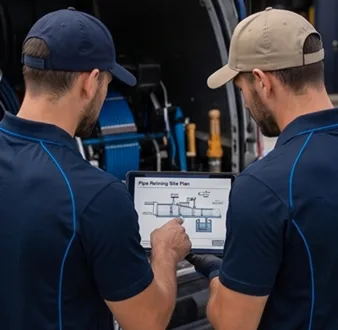

Many Chiswick homes still run their original clay and earthenware drains, which crack and sag over time and trap debris.
On a period property the drainage repair is rarely the expensive part. Tessellated verandah tiles, original brick paving, a mature garden or a heritage-listed frontage all cost far more to reinstate than the pipe underneath costs to fix.
That is the argument for trenchless in one sentence. The liner is drawn through an existing opening and cured in place, so the surface above is never disturbed and there is nothing to match, replace or explain to council.
A food premises line narrows with hardened fat long before it fails structurally. Relining a greased line without addressing the grease simply gives you a smooth new surface to coat, and the interval to the next problem barely changes.
The right sequence is jet it clean, camera it properly, and then decide. If the barrel is sound the answer may be a service schedule rather than a liner. Where the camera shows cracks or open joints under the build-up, relining is worth doing and the smoother bore genuinely slows re-accumulation.
Low-lying streets near the Parramatta River collect heavy runoff and feel high tides, overwhelming older stormwater drains in wet weather.
Ground near water holds more of it, sits lower and moves more through the seasons than ground further up. Pipework laid decades ago has been flexed by that movement for its whole life, and joints open a fraction at a time rather than failing all at once.
It is why faults here tend to arrive as a slow decline rather than a sudden break, and why a camera often finds a run that is uniformly tired instead of one obvious defect. That pattern suits a full-length liner rather than a patch.
People are often surprised that a drain laid before the war is a relining candidate rather than a replacement. Age alone does not decide it. A clay line with a sound barrel and tired joints is close to the best case for a liner.
The cases that genuinely need excavation are different: a collapsed section, a run that has lost its fall, or a pipe crushed out of round. A camera separates those in an hour, and the answer changes the cost by a multiple.
An open joint leaks in both directions. On a low-lying block that means stormwater and groundwater entering the sewer through cracks, which is called infiltration, and it quietly overloads a line that would otherwise cope.
Chiswick is a quiet riverside pocket of Sydney’s Inner West (postcode 2046), sitting on a Parramatta River peninsula and bordering Abbotsford, Drummoyne and Five Dock. Its older homes, leafy streets and low-lying waterfront make it a suburb where drainage needs a local touch, and we know it well.
It shows up as a system that backs up in wet weather and behaves perfectly in dry. If that is the pattern, sealing the run is the fix, and no amount of clearing will reproduce the result.
Drainage work in NSW is licensed work, and work on the sanitary drain is notified to the water authority with a plan showing what was done. That is not a formality: it is what the next owner, conveyancer or insurer refers to.
You should receive the paperwork without asking. If a quote is materially cheaper than the others, it is worth confirming that notification and compliance are included in it.
A recorded camera run with distances marked. Yours to keep, and usually credited if the work goes ahead.
The prevailing 2026 Sydney range for residential sewer relining.
Proportionate for one fault in a sound run. We will recommend it over a full liner when that is what the camera shows.
For a run failing along its length, which on old clay is the common finding.
Plus reinstatement. On a bare lawn it can win. Under anything you would miss, it usually does not.
Figures reflect the 2026 Sydney market rather than a quote. You get your own number once we have seen inside the pipe. Figures here are indicative of the 2026 Sydney market rather than a quote from us, you get your own number as a fixed price before any work starts.

A CCTV survey establishes the material, the diameter, where the defects are and how far they sit from the access. You see the footage, and it is what the quote is built from.
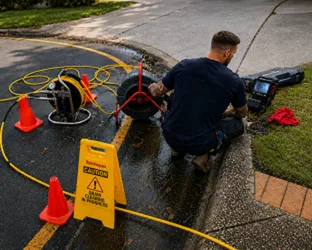
Patch or full length, and occasionally excavation instead. We will tell you when digging is the better answer even though it is the bigger quote.
The run is jetted so the liner bonds to pipe rather than debris, the liner is installed through the existing access, and it cures in place. Most domestic jobs are a single day.

Every branch the liner passed is reopened from inside, then the run is cameraed again so you can see it is continuous and the junctions are clear.
Describe what the drain is doing and how often. We will tell you whether it sounds structural or whether a clean and a maintenance interval is the honest answer.
Straight answers on price, durability and when to dig instead.

Call for the fastest answer, or send the form and we will arrange a camera survey before anything is quoted.

Leave your details and our local Chiswick team will call you back fast.